The Don-Roe (Monroe Doctrine) Is Being Installed
Blog

The Don-Roe (Monroe Doctrine) Is Being Installed
When Donald Trump returned to the White House in January 2025, he didn’t ease into foreign policy. He rewrote the map. What followed wasn’t a collection of provocative headlines — it was a coherent strategic doctrine: a 21st century revival of the Monroe Doctrine, with teeth.
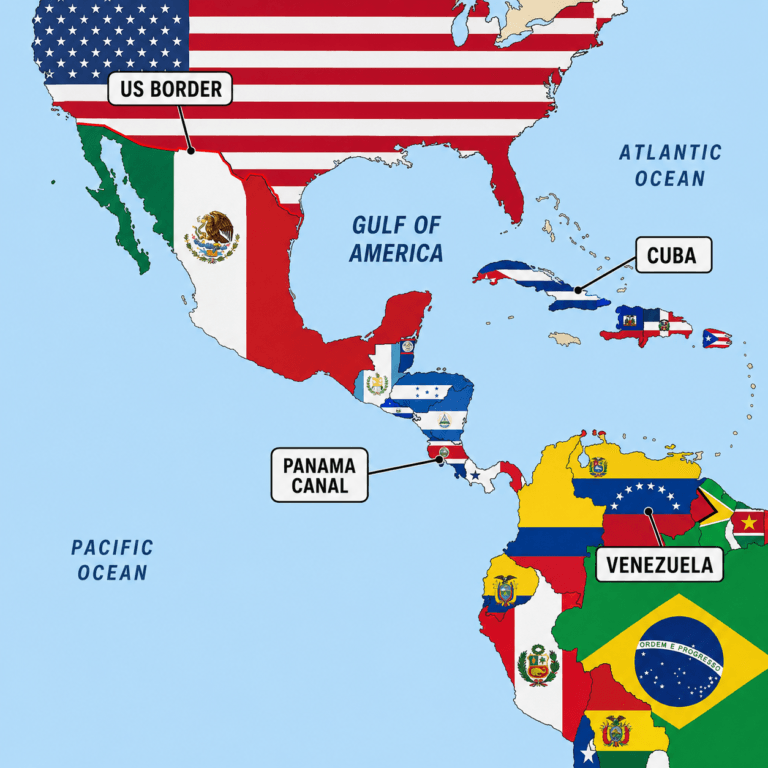
The Gulf of America: Sovereignty Starts at Home
The administration moved immediately to reassert American ownership over its most productive offshore energy zone.
- Trump signed a presidential memorandum renaming the Gulf of Mexico the Gulf of America
- The Gulf holds an estimated 48 billion barrels of undiscovered oil and 141 trillion cubic feet of natural gas
- Federal drilling leases generate billions annually, accounting for roughly 17% of total U.S. crude production
- Expanded offshore leasing followed, reversing Biden-era restrictions
The renaming was symbolic. The drilling expansion was not. Together they signaled that American stewardship of the hemisphere begins in its own waters.
Greenland: The Arctic Imperative
The administration identified the Arctic as a zone of vital national interest requiring active competition against both China and Russia.
- Trump revived and escalated demands for U.S. acquisition of Greenland, refusing to rule out economic or military pressure
- Russia had rebuilt Cold War military installations across its northern coast; China had declared itself a “near-Arctic state”
- Greenland’s territory holds significant rare earth minerals, oil, and gas reserves coveted by all three powers
- Denmark and Greenland’s government refused negotiations, but the U.S. posture shifted Arctic diplomacy permanently
The conversation reframed Greenland from a Danish domestic matter to a live geopolitical contest — one the U.S. had previously been losing by default.
The Panama Canal: Checkmate in Slow Motion
The administration targeted Chinese control of strategic port facilities at both ends of the canal as an unacceptable national security vulnerability.
- Secretary Rubio flew to Panama City February 2, 2025 — his first foreign trip — and formally warned President Mulino the status quo was unacceptable
- Under pressure, Hong Kong-based CK Hutchison agreed to sell its port concessions to a BlackRock-led consortium
- China attempted to insert state-owned COSCO into the deal; the administration rejected it as untenable
- Panama’s Supreme Court ruled the Chinese concessions unconstitutional on January 29, 2026
As Rubio stated plainly at his confirmation hearing: “The ability to do it alone is a threat. We shouldn’t ignore it. It isn’t a joke. It’s a legitimate issue and it needs to be solved.” It was solved within a year.
Venezuela: The Maduro Endgame
The administration moved to collapse Chinese and Russian influence in South America by dismantling their most entrenched client state.
- Reimposed and expanded sanctions; revoked the Biden-era Chevron license that had sustained Maduro financially
- Designated Tren de Aragua as a foreign terrorist organization
- Dramatically escalated deportation flights of Venezuelan nationals
- Captured Nicolás Maduro in early 2026, removing the hemisphere’s most durable authoritarian
The capture dealt a simultaneous blow to Chinese investment security, Russian regional influence, and the transnational criminal networks using Venezuela as a base of operations.
El Salvador and Central America: The Bukele Model
The administration abandoned multilateral aid frameworks in favor of direct security partnerships with results-oriented regional allies.
- Rubio secured an offer from President Bukele to accept deportees of any nationality, including American criminals
- Hundreds of Tren de Aragua and MS-13 members were transferred to El Salvador’s CECOT mega-prison
- The Alien Enemies Act was invoked to circumvent domestic legal challenges to the transfers
- The arrangement became a replicable template across cooperative Central American governments
The Bukele model demonstrated that American security objectives could be achieved faster and cheaper through bilateral partnerships than through the foreign aid bureaucracies they replaced.
Mexico: The Cartel Designation
The administration reframed the southern border from a law enforcement problem to a national security theater.
- Major cartels including Sinaloa and CJNG designated as Foreign Terrorist Organizations
- Active-duty military deployed to the southern border in unprecedented numbers
- Tariff threats extracted historically high levels of Mexican cooperation on migration interdiction
- Cartel financial networks targeted through expanded Treasury sanctions authorities
The designations unlocked military and financial tools previously unavailable against cartel operations, fundamentally changing the legal and strategic framework for border security.
Cuba: Unfinished Business
With every other major piece in place, Cuba remains the doctrine’s final and most consequential objective.
- Cuba re-designated as a State Sponsor of Terrorism; Obama-era engagement channels closed
- Chinese signals intelligence facilities on the island operate within miles of MacDill, Southern Command, Cape Canaveral, and Eglin Air Force Base
- Expanded sanctions cut off remaining financial lifelines to the Castro-era regime
- Maduro’s removal eliminated Cuba’s most important regional patron
The trajectory is clear. A Western Hemisphere systematically cleared of great-power rivals — from the Arctic to the Caribbean — points inevitably toward Havana. The Monroe Doctrine is back. And Cuba is next.

Takeaways from our Audience
Be the first to help unpack with your takeaway