
Rewind: Rubio Explains Chinese Threat to Shipping and Naval Chokepoint at Panama Canal (3:38)
Video/Podcast (opens in new tab)
Source:
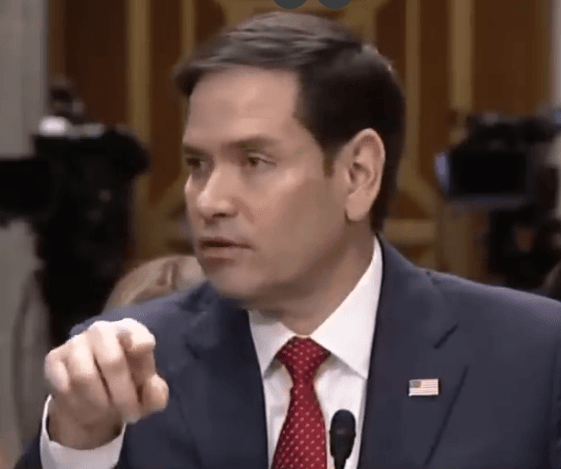
Rewind: Rubio Explains Chinese Threat to Shipping and Naval Chokepoint at Panama Canal (3:38)
At his Jan 2025 Senate confirmation hearing, Sec State Rubio advises the Foreign Relations committee on the dangers of Chinese corporations controlling both ends of the Panama Canal. It was apparently at the top of his agenda when he took office.
The strategic value is somewhat obvious should global conflict arise. Besides, we built it. Aaaaaand… there’s that Monroe Doctrine that keeps appearing in US policy.
Original Source:
Rubio’s Case for Reclaiming the Panama Canal
Long before the Trump administration made the Panama Canal a centerpiece of its foreign policy, Senator Marco Rubio was sounding the alarm. At his Secretary of State confirmation hearing in January 2025, Rubio laid out a systematic case — not of Chinese aggression already underway, but of a strategic vulnerability hiding in plain sight.
The concern, Rubio explained, begins with geography and leverage. Chinese companies control port facilities at both ends of the canal, and that physical presence carries an implicit threat that doesn’t need to be exercised to be dangerous. As Rubio put it, the recently retired head of U.S. Southern Command, General Richardson, “flew over the canal, looked down, and saw those Chinese port facilities and said those look like dual-use facilities that in the moment of conflict could be weaponized against us.”
From there, Rubio went further — arguing that the structural reality of Chinese corporate governance makes the threat even more direct: “Can an argument be made that they basically have effective control of the canal anytime they want? Because if they order a Chinese company that controls the ports to shut it down or impede our transit, they will have to do so. There are no independent Chinese companies.”
How did China get there in the first place? Rubio pointed to a playbook that has been deployed across the Western Hemisphere: “They create deals that you cannot possibly pay back, so now you’ve got a debt you can’t pay back and they have you trapped. Now they’ve got your vote at the UN and your cooperation on X, Y, and Z. That happened in Panama — in 2016, 2017.”
The bottom line, Rubio said, requires no further elaboration: “The ability to do it alone is a threat. We shouldn’t ignore it. It isn’t a joke. It’s a legitimate issue and it needs to be solved.”
Within a year, Panama’s Supreme Court agreed — ruling the Chinese port concessions unconstitutional and handing the Trump administration one of its most tangible foreign policy victories.

Transcript:
QUESTIONER: The challenge — number one — is look, I want to be clear about something: the Panamanian government, particularly its current officeholders, are friendly to the United States and very cooperative, and we want that to continue. And I want to bifurcate that from the broader issue of the Panama Canal.
RUBIO: Now, I am not — President Trump is not — inventing this. This is something that’s existed now for at least a decade. In my service here, I took a trip to Panama in 2017. On that trip to Panama in 2017, it was the central issue we discussed about the canal — and that is that Chinese companies control port facilities at both ends of the canal, the east and the west. And the concerns among military officials and security officials, including in Panama at that point, that that could one day be used as a choke point to impede commerce in a moment of conflict.
That goes back to that. But I cited earlier — before you got here, and I don’t want to have to dig through this folder to find it again — basically the immediate past head of Southern Command, just-retired General Richardson, said she flew over the canal, looked down, and saw those Chinese port facilities and said those look like dual-use facilities that in the moment of conflict could be weaponized against us. The bipartisan China Commission over in the House last year had testimony and hearings on this issue, and members of both parties expressed concern. The former ambassador to Panama under President Obama has expressed those concerns. This is a legitimate issue that needs to be confronted.
The second point is the one you touched upon — and that is, look, could an argument be made — and I’m not prepared to answer it yet because it’s something we’re going to have to study very carefully, but I think I have an inkling of where this is going to head — can an argument be made that they basically have effective control of the canal anytime they want? Because if they order a Chinese company that controls the ports to shut it down or impede our transit, they will have to do so. There are no independent Chinese companies. They all exist because they’ve been identified as national champions. They’re supported by the Chinese government, and if you don’t do what they want, they find a new CEO and you end up being replaced and removed. So they’re under the complete control of their government. This is a legitimate question.
QUESTIONER: Senator Rich had some insight as well — he mentioned that in passing. That needs to be looked at. This is not a joke. The Panama Canal issue is a very serious one. And so the mere potentiality of that — the ability to exercise that control, even until such time as they do shut it down — is a concern, is it not?
RUBIO: Well, I listened 48 hours ago to FBI Director Wray in one of his exit interviews he gave to the press, and he said the Chinese are embedded in our utilities and critical infrastructure. Now, he didn’t say every single day they’re shutting off the power in the United States. He said that if there’s a conflict, they’re embedded and they could shut off the power in key places. We’ve all identified that as a threat. The fact that you can do it — you don’t have to do it every day. No one’s claiming that the Chinese are shutting down the canal every day. What the claim is — the very legitimate concern is — that if these companies control both ends of that canal in a time of conflict and the Chinese tell them shut it down and don’t let the US go through there, we’ve got a big, big problem. A big economic problem and a big national security and defense problem. The ability to do it alone is a threat. We shouldn’t ignore it. It isn’t a joke. It’s a legitimate issue and it needs to be solved.
QUESTIONER: Excellent. That feeds right into the next thing I wanted to ask you about, which involves areas of dual-use capabilities throughout the Western Hemisphere — ports, infrastructure, critical minerals, and so forth. We’ve had policies from the Biden Administration involving the supercilious use of untargeted foreign aid and sort of cultural coercion — an effort to coerce some of these countries to adopt policies contrary to their established cultural norms: abortion rights, LGBT policies and curriculum, and so forth. That probably hasn’t helped in this still somewhat soft conflict in which many of these countries are opening their doors to China. How will your approach to Chinese incursion in the Western Hemisphere be different from that of the current Administration?
RUBIO: Well, there are a couple of points. The first is the Chinese incursion in the hemisphere involves — number one — investment of dollars. As an example, they go into some country and say, “Here’s $5 million or $10 million to build a stadium. But in exchange, you have to let us build out your 5G network using Huawei, safe cities, and the like. And by the way, here’s a couple million dollars for you and your friends” — which is a bribe. That’s their first level of engagement. And then in some ways they create deals that you cannot possibly pay back, so now you’ve got a debt you can’t pay back and they have you trapped. Now they’ve got your vote at the UN and your cooperation on X, Y, and Z. That happened in Panama by the way, in 2016, 2017 — it was well understood that part of the investments they made in Panama were conditioned upon Panama’s ability to convince the Dominican Republic and other countries to flip their recognition away from Taiwan. That happened.
Number two: they go into a country and a Chinese company will buy up the lithium mines or access to the rare earth minerals in long-term contracts. That exists in allied countries. The Argentines will tell you there are a number of business deals that Chinese companies have gotten a hold of in Argentina that even if they wanted to back away, they can’t get out of, because of the way they were structured.
And then number three is their presence. The Chinese are actively involved in military installations in the Western Hemisphere — on the island of Cuba, 90 miles from our shores, only a few hundred miles from where Space Force operates, and NASA, and Cape Canaveral. Only a few miles from MacDill, where we have Central Command and Special Operations Command. Only a few miles from Southern Command. Only a few miles from Eglin Air Force Base and the test range we have out in the Gulf of Mexico. All of these things — this is real, and it’s operating right off the coast of the United States.
They have a presence in our region. So we have to acknowledge that this is happening, and then we have to be present and have counters to each of these — and/or there have to be consequences for each of these. Fortunately, the United States has strong relationships in multiple key countries in the region, and I think we have the opportunity to build upon that in ways that can attract the sort of investment that they would rather have than the Chinese investment. But right now, it’s not available. It’s not happening. There is no American alternative to what the Chinese are offering. So hopefully we can provide the openings for that.
QUESTIONER: Indeed. I appreciate your enthusiasm and thoughtfulness in providing that answer. Now, you touched on another issue when you referenced the significance of agreements made by prior administrations. Obviously the Milei Administration in Argentina wouldn’t have been as likely to enter into those arrangements as his predecessor was. The United States — we have to keep this in mind — the Constitution allocates the treaty-making and binding power and spreads it out between two branches. The president can enter into a treaty, can sign a treaty, but that treaty isn’t ratified unless two-thirds of the Senate does it. Would you agree with me that ratification by the Senate is a necessary precondition for an international agreement to be binding on the United States beyond the administration that entered into it? This was the case with the JCPOA, which was being sold to people as a treaty but wasn’t — and that’s why President Trump had the authority to pull us out of it when he did.
RUBIO: I think what’s important to understand about treaties in general — and we’ve talked about treaties here today — is that every treaty, by definition, is a surrender of sovereignty at some level as a nation. But you do it. You enter into it. Why? Because you’ve concluded that that surrender and the benefit of it to the national interest or national security far outweighs the surrender of sovereignty and the consequences of it. And that is why it’s so critical that the Senate be involved in that deliberation — because an individual administration may get that calculus wrong. But when you have this overwhelming majority that concludes that it too agrees that the surrender of sovereignty is exceeded by the benefit of the treaty, now you know you’ve increased your chances of having something that’s good and makes sense. So I agree with your view of it, and I think that’s the way I would hope we would pursue arrangements in the future if we enter any. That’s why it takes two-thirds.
QUESTIONER: Thank you so much, Senator Rubio.
RUBIO: Thank you, Mr. Chairman.
Takeaways from our Audience
Be the first to help unpack with your takeaway